 MINT
Direct property versus REITs in Ghana: how to compare them
Understand property ownership, rental returns, Ghanaian REITs, entry costs and how to get your money out before you invest.
Before we begin
When someone says they invest in real estate in Ghana, you may picture land, a house, apartments or a shop. But you can also gain exposure through a Real Estate Investment Trust, abbreviated REIT and pronounced “reet.”
These routes involve different rights, responsibilities and exit arrangements. A building can be attractive while the investment terms are unsuitable for you.
By the end of this lesson, you should be able to compare total costs, calculate a simple rental surplus, explain what a REIT investor owns and ask practical questions about getting your money back.
All classroom amounts below are fictional. They are not Ghanaian property valuations, market rent estimates or promised investment returns. Product references are educational, not recommendations.
Step 1: understand what you would own
Direct property: you acquire a legal interest in a particular property. That interest might be a leasehold with a remaining term and conditions. Do not assume every land purchase gives unlimited ownership forever.
A REIT: you buy shares or units in an investment vehicle with real-estate exposure. Your rights follow its structure and governing documents. You do not receive a specific office, shop or room for your personal use.
The distinction matters when decisions arise. A direct owner may decide how to renovate, subject to applicable permissions and agreements. A REIT investor relies on the manager and the vehicle's governance; they do not personally choose each tenant or repair.
A direct owner can also hire a property manager. That reduces daily work, but adds costs and does not remove the owner's responsibility to oversee the investment.
Step 2: check the property before paying
Imagine Kojo is offered land near Tema. The seller shows him a site plan and says another buyer is ready to pay. Urgency is not a substitute for checks.
Kojo should work with an independent Ghanaian property lawyer and qualified survey professional to establish:
- The seller's authority: who holds the interest, and who can legally transfer it?
- The exact parcel: do the boundaries on the ground match the plan and documents?
- The records: what do appropriate official searches reveal about registered interests or restrictions?
- The interest offered: what term, conditions, consents and obligations apply?
- The proposed use: can he lawfully use or develop it as intended?
- The completion process: what must be signed, paid, approved and registered?
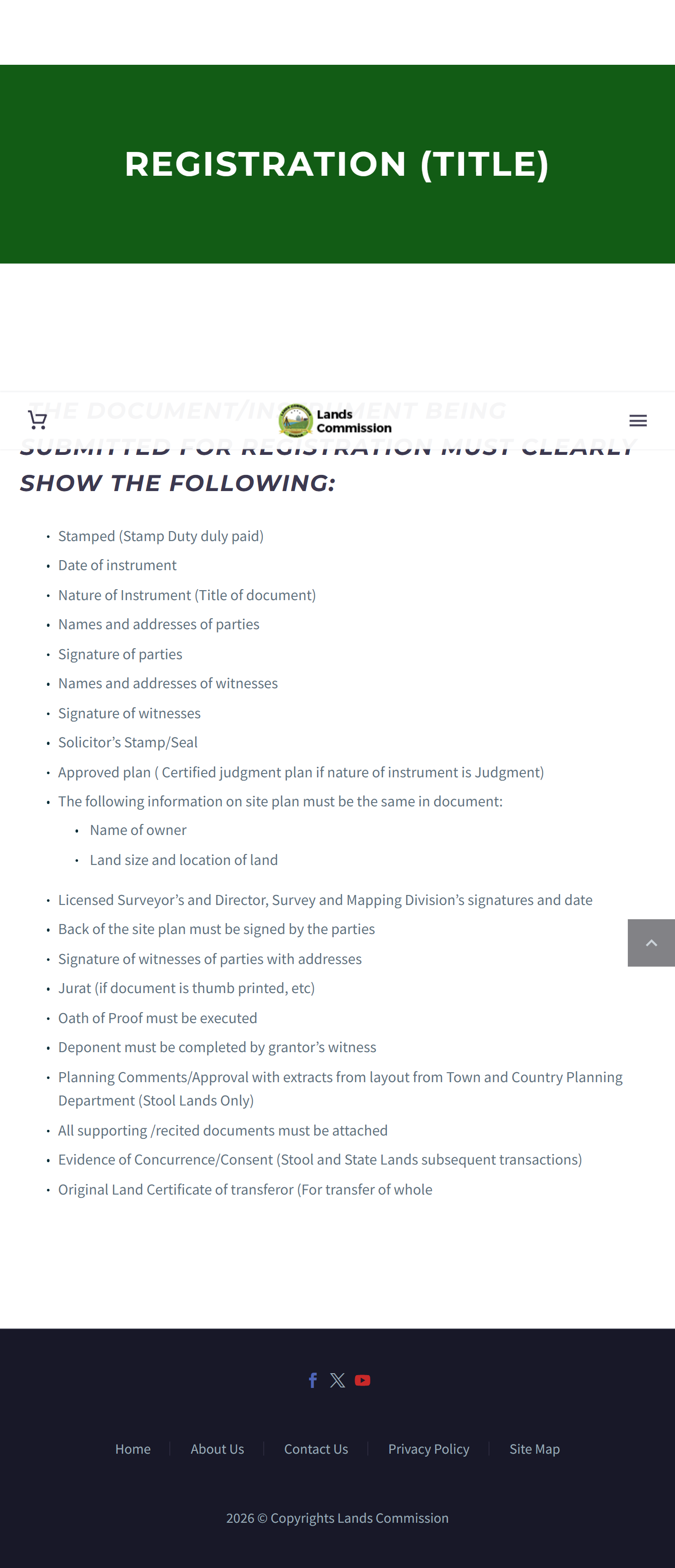
The Lands Commission provides search and registration services. Its title-registration requirements include consistency between the site plan and instrument, supporting documents and relevant consent evidence. The appropriate process depends on the transaction. A search is one part of due diligence, not a substitute for checking the site, seller and legal documents. See the Lands Commission service charter and title-registration requirements.
See the Lands Commission registration checklist
Step 3: calculate the full starting cost
Abena is assessing a fictional rental property in Kumasi. She is buying without a loan in this classroom example.
| Starting item | Illustrative amount |
|---|---|
| Property price | GHS 500,000 |
| Combined acquisition and initial preparation costs | GHS 50,000 |
| Total starting cost | GHS 550,000 |
The second line is a teaching assumption, not a quotation for legal fees or government charges. For an actual purchase, obtain separate estimates for searches, legal work, registration, applicable taxes, agency fees and initial repairs. Avoid counting the same item twice.
An instalment plan changes when money is paid; it does not make the remaining obligation disappear. Construction adds completion and cost-overrun risk. A mortgage adds interest, fees and repayment commitments.
Ask yourself: After acquiring the property, will I still have enough cash for repairs, vacancies and my own emergencies?
Step 4: separate rent from the money you keep
Assume Abena expects rent equivalent to GHS 3,000 a month. This is an annual income illustration, not guidance about rent-advance arrangements.
| Year-one calculation | Amount |
|---|---|
| Rent if occupied and paid for all 12 months | GHS 36,000 |
| Two months without rental income | −GHS 6,000 |
| Rent actually earned and collected in this example | GHS 30,000 |
| Repairs, insurance and management costs | −GHS 9,000 |
| Rental surplus before financing and tax | GHS 21,000 |
Work through the arithmetic:
GHS 3,000 × 10 occupied, paid months = GHS 30,000.
GHS 30,000 − GHS 9,000 = GHS 21,000.
Relative to her full GHS 550,000 starting cost, that is about 3.82% before financing and tax: 21,000 ÷ 550,000 × 100.
Compare that with quoting 36,000 ÷ 500,000 = 7.2%. The larger number uses full occupancy, ignores operating costs and divides by the purchase price alone. Both calculations must be labelled; they answer different questions.
If Abena has a loan, she must also budget debt service. Loan principal repayments affect cash available even though they are not the same as an operating expense. A large repair or unpaid rent can further reduce the cash she keeps.
Try it: what if there are four empty months instead of two?
Eight paid months give GHS 3,000 × 8 = GHS 24,000. Holding the illustrative operating costs at GHS 9,000 leaves GHS 15,000 before financing and tax, or about 2.73% of the GHS 550,000 starting cost. Actual costs may also change.
Step 5: distinguish appreciation from cash
Someone estimates Abena's property is now worth GHS 650,000. That estimate is not a completed sale.
She still needs a willing buyer, an agreed price and a completed transaction. Selling expenses and any outstanding loan also affect her net proceeds.
Liquidity means how readily you can turn an investment into cash at an acceptable price. A direct property sale can take time. Needing cash urgently may weaken your bargaining position.
Land that produces no rent depends on a different plan: future use, development or sale. Do not apply a rental-income calculation to an empty plot that has no tenant or income arrangement.
Step 6: follow the money inside a REIT
A simplified income-producing property structure works like this:
Investors supply capital → the vehicle invests in property → tenants pay rent → costs are met → eligible income may be distributed.
The SEC's REIT framework provides for a manager and custodian. Professional management changes who does the work; it does not guarantee income or capital. See Ghana's REIT Guidelines.
Read the actual portfolio. A vehicle holding a small number of buildings, or depending heavily on one tenant, is not automatically broadly diversified. Rental income can fall when tenants leave or fail to pay. Debt and fees can reduce what is available to investors.
Distributions and changes in investment value are different parts of your return. In a purely fictional example, a GHS 10,000 holding pays GHS 400 but falls to a quoted value of GHS 9,000. Cash received plus the change in value is −GHS 600 before fees and tax. The GHS 1,000 valuation fall remains unrealised unless sold at that value; an actual sale price may differ.
Step 7: recognise Ghanaian options without assuming identical terms
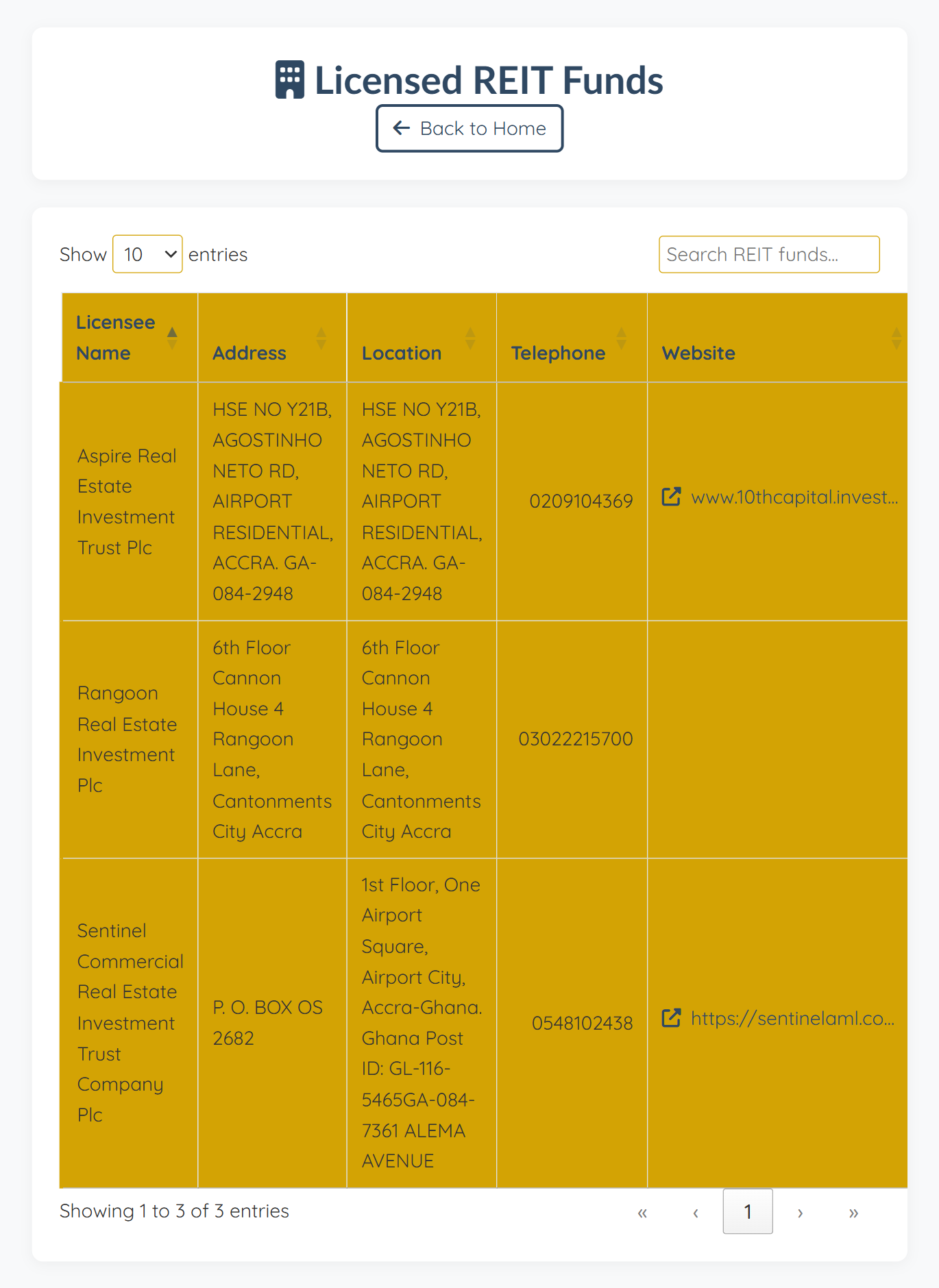
Checked on 12 October 2026, the SEC's dedicated REIT register lists:
- Aspire Real Estate Investment Trust Plc.
- Rangoon Real Estate Investment Plc.
- Sentinel Commercial Real Estate Investment Trust Company Plc.
Republic Real Estate Investment Trust appears separately on the SEC's unit-trust register, with Republic Investments (Ghana) Limited as manager. Check both the exact product and its manager. Registration does not establish that an offer is open, that it suits you, or that you can exit immediately. Sources: SEC REIT register and SEC unit-trust register.
See the SEC register screenshot
Rangoon: a historical entry-cost example
Rangoon's 2025 prospectus identifies IC Asset Managers (Ghana) Limited as manager and describes exposure involving Infinity Tower and Portman House, also called the Huawei Building, in Cantonments City. This is a prospectus description, not independent confirmation of today's holdings.
That initial offer specified 300 shares, each at the cedi equivalent of USD 1,000. The minimum therefore equalled USD 300,000 in cedi terms. This is not a current price, minimum or availability statement.
It also describes manager-facilitated over-the-counter transfers before listing and GSE rules after listing. A planned listing is not evidence that exchange trading is available today. Source: Rangoon prospectus, offer and transfer terms.

Sentinel and Republic: ask for each product's documents
Sentinel describes its commercial REIT as a closed-ended scheme. Republic describes its REIT among its managed products. Obtain current written terms from the respective managers; do not apply Rangoon's minimum or transfer arrangements to either product. Sources: Sentinel product information and Republic product information.
REIT does not automatically mean a small starting amount. Equally, one large historical offer does not prove that every Ghanaian real-estate fund has the same entry barrier. Ask for the actual minimum, eligibility, fees and dealing terms.
Step 8: ask how you enter—and how you leave
Before paying for a REIT or property fund:
- Match the legal product name to the SEC register and verify the manager through official contacts.
- Request the current prospectus, recent audited accounts, portfolio report and fee schedule.
- Confirm whether subscriptions are open or you must buy from an existing holder. Check eligibility and minimum investment.
- Ask how the price is determined, the payment currency and any currency-conversion basis or charges.
- Complete the required identity and account documentation through verified channels. Keep the receipt and ownership statement.
- Get the exit process in writing before funding the investment.
For the last step, ask:
| Question | Why it matters |
|---|---|
| Does the fund redeem holdings, or must I find a buyer? | Redemption and selling to another investor are different processes. |
| Is exchange trading available now? | A prospectus may describe a future plan. |
| What notice, approvals or restrictions apply? | You may be unable to exit on your chosen date. |
| How is the exit price set? | A reported asset value is not a guaranteed sale price. |
| What fees and settlement time apply? | Agreed sale proceeds may not be immediately available to spend. |
| What happens if there is no buyer? | A transfer mechanism does not guarantee demand. |
A closed-ended structure generally requires particular attention to transfers and the availability of buyers; do not assume an on-demand withdrawal facility. Even where exchange trading exists, a sale still depends on buyers, price and settlement.
Step 9: compare the routes on the same basis
| Decision | Direct property | REIT or real-estate fund |
|---|---|---|
| What you hold | A legal interest in a particular property | Shares or units in the vehicle |
| Entry cost | Price plus acquisition and preparation costs | Product-specific minimum, price and fees |
| Daily work | You or a manager you appoint | The vehicle's professional managers |
| Potential income | Rent after relevant costs | Distributions under the product's policy |
| Control | More direct control, subject to legal limits | Investor rights under governing documents |
| Concentration | Often one property or location | Depends on actual assets and tenants |
| Exit | Find a buyer and complete the sale | Product-specific redemption or transfer route |
| Main checks | Title, condition, costs, tenants and sale prospects | Licence, portfolio, manager, debt, fees and exit terms |
Neither route promises appreciation or reliable cash every month. Both can expose you to property-market changes, vacancies and rising costs. If income, debts or pricing reference different currencies, understand who bears exchange-rate changes.
Step 10: write your own decision note
Before choosing a product, complete these sentences:
- My goal is: income, long-term growth, future personal use, or another specific purpose.
- My available budget is: the investment amount plus a separate cash buffer.
- I can leave the money invested until: a realistic date, allowing for possible exit delays.
- The full costs I have checked are: acquisition or subscription, ongoing and exit costs.
- My main risks are: the specific property, tenants, financing, manager or restrictions involved.
- My route back to cash is: the actual sale, transfer or redemption process.
If you cannot complete the last sentence, you are not finished researching. Keep money needed for near-term essentials outside an investment whose exit timing is uncertain.
Continue with mutual funds and unit trusts to understand pooled investments. The savings-goal tool can help plan contributions toward a target; it does not predict property or REIT returns.
Your practical task
Choose one direct-property opportunity and one Ghanaian real-estate investment vehicle to research. Fill in the comparison table using actual documents and quotations. Leave unknown fields marked not confirmed rather than guessing.
You do not have to invest immediately. The first useful result is knowing what you would own, what it would cost, how it could earn and what must happen before you get your money back.
Check your understanding
Choose an answer to see why it works or what to reconsider. You can try every answer. Nothing is scored or saved.
This is general financial education, not financial advice. Figures are illustrative. Speak to a licensed professional before making investment decisions.
Figures as of 12 October 2026; historical offer terms are labelled; teaching examples are fictional. Sources: SEC Ghana: licensed REIT funds (checked 12 October 2026), SEC Ghana: licensed unit trusts (including Republic REIT), SEC Ghana: Securities Industry (REITs) Guidelines 2019, Rangoon REIT: prospectus, historical 2025 offer, Sentinel Asset Management: commercial REIT product information, Republic Investments Ghana: products, Lands Commission: title registration requirements, Lands Commission: Client Service Charter